Ask anyone what their development plan says and watch what happens. Most cannot tell you. They can tell you their level, and they can tell you their number, because those two arrived in the same conversation and one of them was money. The plan was in there somewhere. It was heard as the reason for the number, and nobody remembers the reason for a number.
Development is the one conversation in a review cycle where a person can afford to be wrong. A review that admits a weakness lowers a mark. A comp conversation that admits one lowers a number. A development conversation that admits one is doing its job. Put all three in one document and nobody admits anything, and the plan that comes out is a list of things the person is already good at.
A review tells you where you are. A map tells you which way is up from there, and that there is more than one.
The development industry runs on one number, and it is worth knowing where it came from. The 70-20-10 rule — seventy percent of growth from challenging assignments, twenty from relationships, ten from courses — comes from the Center for Creative Leadership in the late eighties, from asking 191 successful executives to recall what had made them. The percentages are what those executives remembered, and the phrase never appears in the book it is attributed to. But the shape held up under later work, and the shape is the useful part: people grow by being handed decisions, far more than by being told about them. Which is what the leveling framework was built around, and why development has to be a document about decisions rather than a list of courses.
Six axes, not equally teachable
The leveling framework grades on six axes. A development plan that treats them as equally growable will spend a quarter on the wrong one, because they are not. Two of them are almost entirely in the manager's hands, one moves fastest of all, and one barely moves at all.
What can be grown, and by what
The axis the leveling framework weights most — decision rights, which carries the veto — is the one the person can do least about alone. A plan that does not include a move by the manager is not a plan for promotion.
The two shaded rows are the ones to build a plan around: the fastest-growing axis, and the one that gates promotion. One is the person’s move. The other is the manager’s. When I cut the Lyft multimodal team from twenty to seven, two of the seven were mid-level and had never held a decision at that scale. They were handed one. Nothing in their development plans had prepared them for it and nothing needed to; what they were missing was not growable, it was grantable, and it took a manager to grant it.
Marks as a shape
The calibration record gives six marks: below, at, or above the person's level on each axis. Read as a score, that is a grade, and a grade is what a review is for. Read as a shape — six spokes, three rings — it is a map, and the shape says which move to make. It takes a minute to draw and it changes the conversation from "you scored at on four axes" to "you are a craft peak, and here is what craft peaks do next."
Six shapes
Most people's marks fall into one of these, and each has a usual move. The one to notice is the fifth.
Before the conversation, the manager draws the same six spokes for what they did this quarter to grow this person. A person’s map that has not moved in two quarters beside a manager’s map that is empty is not a person who has stalled.
Four moves
Every development plan is one of four moves, and naming which one is the whole plan; the rest is the work that carries it. One move per quarter. A plan with three moves in it is three quarters of work in one, and the person will do the easiest.
The four moves, and what the manager owes for each
Every move has a manager-side obligation, and the conversation ends with both written down. A development plan without a manager task is a task list with a nicer name.
Widen is shaded because it is the highest-return move available. The overlap band means most of what a designer needs from product, or an engineer from design, is now learnable by doing it beside someone rather than by studying it.
The AI Daily Brief put the same move in one line this July: become the maker for your function. When making gets cheap, every function grows a maker, and the person who brings prototyping into finance or research or design ops is the one who ends up central to whatever that function becomes. On this map that is a widen move, and it is the reason range is the fastest-growing axis rather than the softest. The same episode made a second point this document leans on: the archetypes it describes map to temperament, not to title. So do the six shapes above. A craft peak is not a phase; it is a person, and the plan has to start from who they are.
A stretch is a decision
Most stretch assignments are ordinary work with an encouraging label. A real one names something the person will decide alone that they have not decided before; asks for one behavior from the level above, on one named axis, rather than "operate at level 4"; can fail without the company or the person being damaged, because a stretch that cannot fail safely is a test and people know the difference; and has somebody named who will read the decision trail afterward and say whether the axis moved.
The brief is half a page and the critical line is the second: the decision you will make alone. If that line cannot be written, the assignment is not a stretch, whatever it is called.
What the manager owes
Gallup has been saying for a decade that the manager explains about seventy percent of the variance between a company’s most and least engaged teams. That is engagement, not development, but the finding points the same way, and everybody nods at it and nobody writes down what the manager is therefore supposed to do. The pattern I saw most often coaching heads of design, and later among Amsterdam’s operating leaders, was a leader who could describe a report’s growth in detail and could not name one thing they had done that quarter to cause it. Development is the one document where a manager’s obligations can be listed and checked, and the list is short:
- A conversation, quarterly, producing a one-page plan.
- One decision handed over, named, that the manager made last quarter.
- One room opened, and the question asked afterward.
- Cover given, in public, when a position went wrong.
- Encoding time protected, with the delivery that moved to make room named.
- The manager’s own map, drawn, and shown to their manager.
The report’s growth is the manager’s output. If the map has not moved in two quarters, the first question is what the manager did.
Which is also how you tell whether development is happening across a company without re-grading anyone mid-cycle and turning the third document back into the first. Count the decisions handed over. Count the pairings running. Count the plans that contain a manager task. At the next calibration, count the maps that changed shape — not improved, changed. And count the transfers, because zero means the doors are painted on.
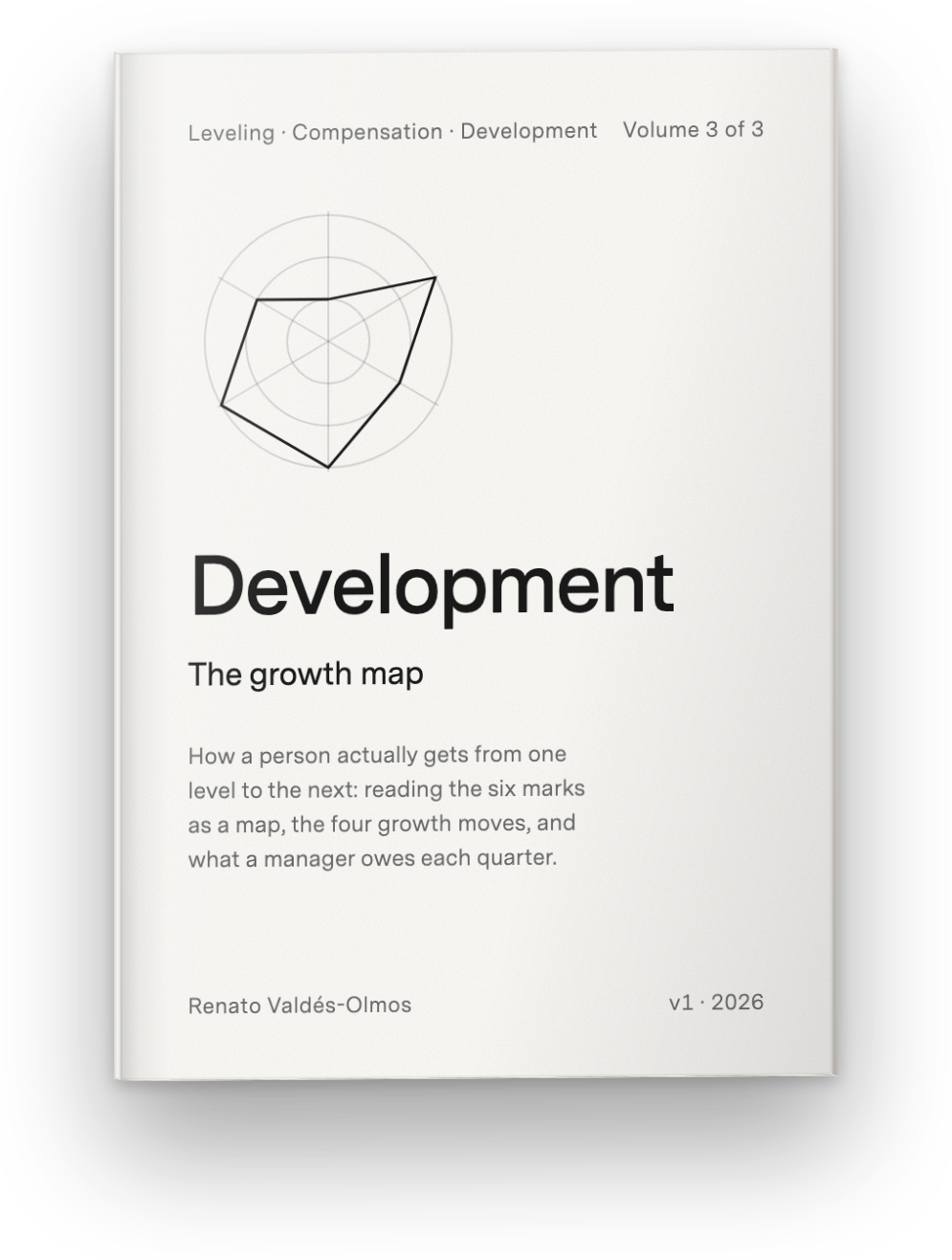
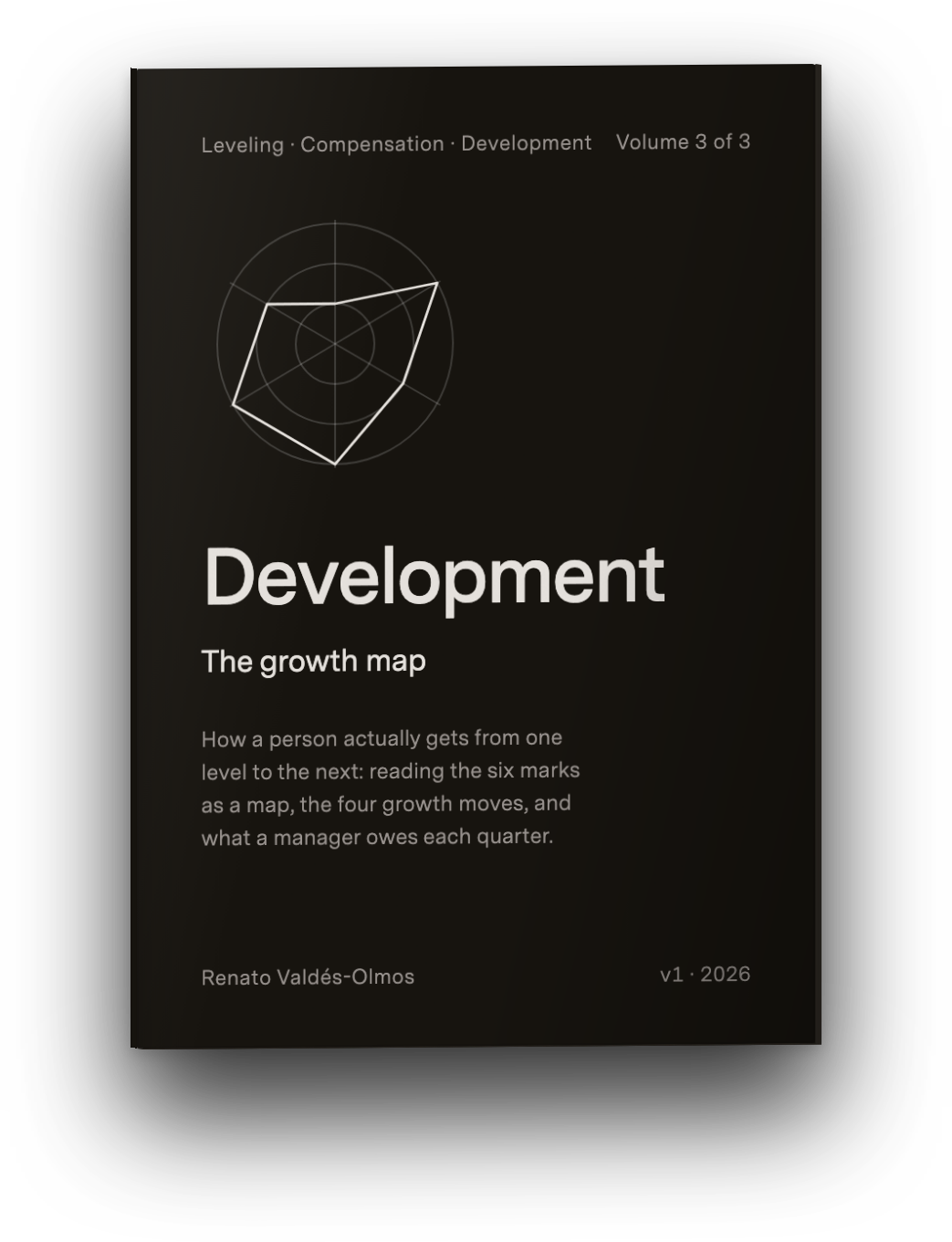
The growth, separately
A review says where somebody is. This is how they get somewhere else.
The essay argues that development is the one conversation in which a person can afford to be wrong, and that it dies the moment it shares a document with the review or the raise. The workbook is the third document: the six marks read as a shape rather than a score, the four moves that actually change a level, a stretch brief that names the decision, pairing across lanes, and the list of what a manager owes each report every quarter.
Written to be opened during a cycle rather than read once: on the page, as a PDF set to print, and with the templates as a spreadsheet.
Or read section two, free.
v1. The quarterly cadence and the stretch brief are the ones I have run at companies of 25, 250 and 2500 people; reading the six marks as a map is new. One payment, every revision by email.
A companion to the four essays on leveling — design, engineering, product and research — and to pay is a separate document, which handles the second of the three jobs. The quarterly cadence and the stretch brief are drawn from practice; reading the six marks as a shape, and the four moves, are the part that departs from convention.
© 2026 Renato Valdés-Olmos