Go looking for a canonical research career ladder the way you can find Merholz for design or Fournier for engineering or Mehta for product, and you will not find one. There are conference talks and a scatter of company posts. There is no document the field argues about, and that absence is the most interesting fact about the discipline.
It is not that research organizations have no levels. Mine did, at Grammarly and again at Pitch, where research reported into the organization I ran. Researchers were hired at a level, paid at a level, promoted between levels, and the levels mirrored the product design ladder almost exactly: same count, same compensation bands, same expectations about scope and autonomy translated into research language.
That mirroring was the sensible thing to do at the time. Research reported into design, design had the nearest usable standard, and building a fifth document from scratch for a team of that size would have been ceremony. But a borrowed ladder inherits the assumptions of the discipline it was borrowed from, and design's assumptions are not research's.
Every research ladder I have seen is a design ladder with the nouns changed.
What the field has to work from
The whole shelf
This is the whole shelf, and the point of the essay is how short it is. There is no research equivalent of Fournier or Mehta — nothing the field argues about, only documents individual companies happened to publish.
Two things are true of nearly all of them. Research is carried inside somebody else’s framework rather than given its own, and the ladder stops early: the complaint that there is nowhere left to grow is a structural fact about the documents, not a mood.
I have some sympathy for the borrowing, because I know what the alternative costs. At Honor, where I was the founding designer, the first research program was one I ran myself, in the homes the product was for, before the product had a name. Nobody leveled it, because there was nobody to level it against. When the team grew to twenty across product, brand, design ops and research, the researchers were leveled against the designers, because the designers had a ladder and the alternative was writing one in a week I did not have.
What the borrowed ladder got wrong
Mirroring design was a defensible shortcut and it was also wrong in a specific way. A design ladder measures the progression from executing a screen to owning a surface to shaping a strategy, and each level is anchored in artifacts somebody can look at. Transposed to research, that progression becomes: runs a study, owns a research area, shapes what the company believes.
The first two translate. The third does not, because the thing that separates a strong senior researcher from a strong staff one is not the size of the area they cover. It is whether the organization changed its mind.
At Pitch the research team produced the finding that turned the company’s plan. It was not a large study. It was the right question, asked once, with the nerve to bring back the answer nobody had ordered, and it changed what the company believed about itself. Under the borrowed ladder that work scored as a single study in a single quarter. A researcher can run flawless studies for two years, produce reports everybody praises, and change nothing. Under a borrowed design ladder that person looks promotable: their scope grew, their studies got more complex, their stakeholder list got longer. Under a research ladder that measures the right thing they are stuck, and everyone senior can feel it without being able to point at the row that says so.
The design ladder, with the nouns changed
What happens when a research ladder is transposed from a design one. Four of the rows survive the translation. Two arrive meaning something they cannot measure, and one of them is the row the discipline actually turns on.
The shaded rows are the ones that do not survive the transposition, and they are the two that separate a strong senior researcher from a strong staff one. Everything above them is a measure of activity.
The border is not with design
The other thing the mirror got wrong is where research actually sits. Because research usually reports into design, the assumed adjacency is with design. In practice the live boundary is with data science and analytics, and it has been for years.
The questions are the same questions. Why did this cohort stop coming back. What do people actually do with the feature. Which of these two explanations for the number is true. One side answers with interviews and a synthesis, the other with a query and a chart, and in most companies the two sides sit in different reporting lines and meet at a readout.
What has changed is that the tooling collapsed. A researcher who can write the query is no longer unusual. An analyst who can run six conversations to work out what the drop-off means is no longer unusual either. Synthesis, the thing that was supposed to be the researcher's protected craft, is now the thing most obviously assisted by a machine, which is uncomfortable and worth saying plainly.
It is also, already, a role. When The AI Daily Brief mapped the team of a company running on agents this July, the scout — the one who aggregates signal from the world — was the archetype most often filled by an agent rather than a person. Scouting is most of what a research ladder has been measuring at levels one to three. What it never measured, and what no agent has a stake in, is which question is worth the company’s attention.
Research and Data science
The live border, and the one no research ladder is drawn against. Synthesis moved into the shared column in about two years, which is why the middle of the ladder is where this hurts.
Research and Product
The border everybody expects research to have with design, it actually has with product — and it is a border about evidence rather than about craft.
What survives
If a model can cluster forty transcripts into themes faster and more consistently than a person, and it can, then thematic synthesis stops being a level. It becomes a step. This is the same collapse that happened to visual execution in design and to estimation in product, and it lands hardest on the middle of the ladder, where most researchers are.
Three things survive it, and they are what I would build a research ladder on.
Question quality. The most consequential act in research is deciding what to ask, and it happens before any method is chosen. A researcher who reliably converts a vague stakeholder anxiety into a question worth twelve interviews is doing something no tool does, because the tool has no stake in the answer.
Evidentiary honesty. Knowing what a finding can carry. Six interviews do not support a roadmap decision and everybody in the room wants them to. The researcher who says so, when saying so kills a plan somebody has already staffed, is operating at a level the borrowed ladder has no row for.
Belief change. Not reports delivered, not studies run, not stakeholders served. Which of the company's beliefs is different because this person worked here, and does it still hold. This is the hardest to measure and it is the only one that separates the top two levels.
The six axes, in research’s language
Three of the six levels. The row a borrowed ladder cannot produce is the third one down.
The opinions-held row is the one no borrowed ladder can produce, because it has no ancestor on the design side. It is also the row that makes belief change gradeable rather than aspirational.
Why the field never settled one
I think the reason there is no canonical research ladder is that research teams are small enough to run on borrowed standards and just large enough for that to fail quietly. At six researchers, the design ladder with the nouns changed works well enough. At twelve it does not, but the failure shows up as an unexplainable promotion decision two years later rather than as a visible gap, so nobody traces it back to the borrowed document.
The other reason is that writing one down means committing to belief change as the measure, and that measure is uncomfortable for exactly the people who would have to write it. It makes a researcher's level partly dependent on whether the organization listened, which feels unfair, and is unfair, and is also true.
The fix is not to score them on something they fully control. It is to hold the organization to the same row: if research is not changing what the company believes, that is a finding about the company, and it should appear in somebody else's review.
The whole system
You can read the argument for free. Running it is the hard part.
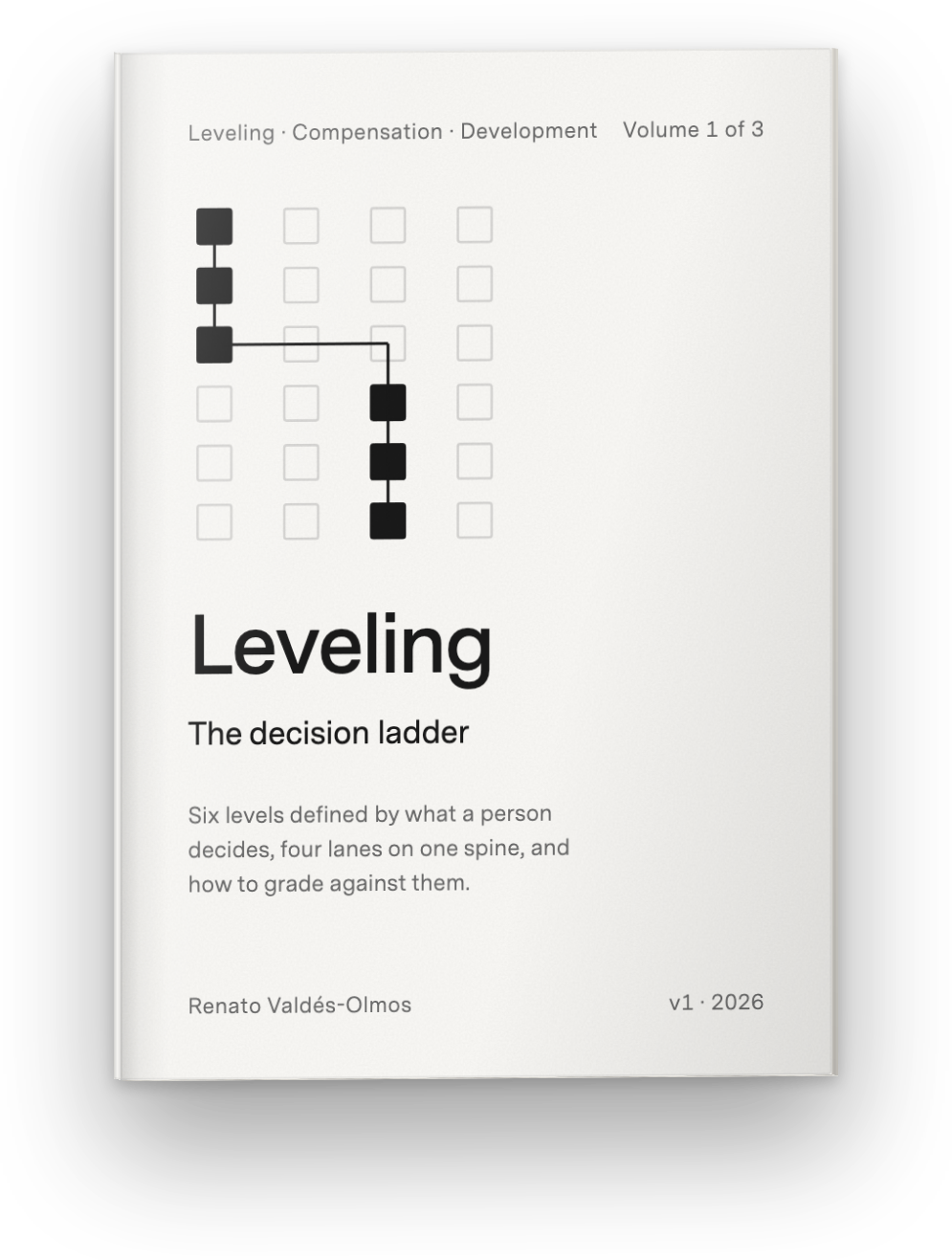
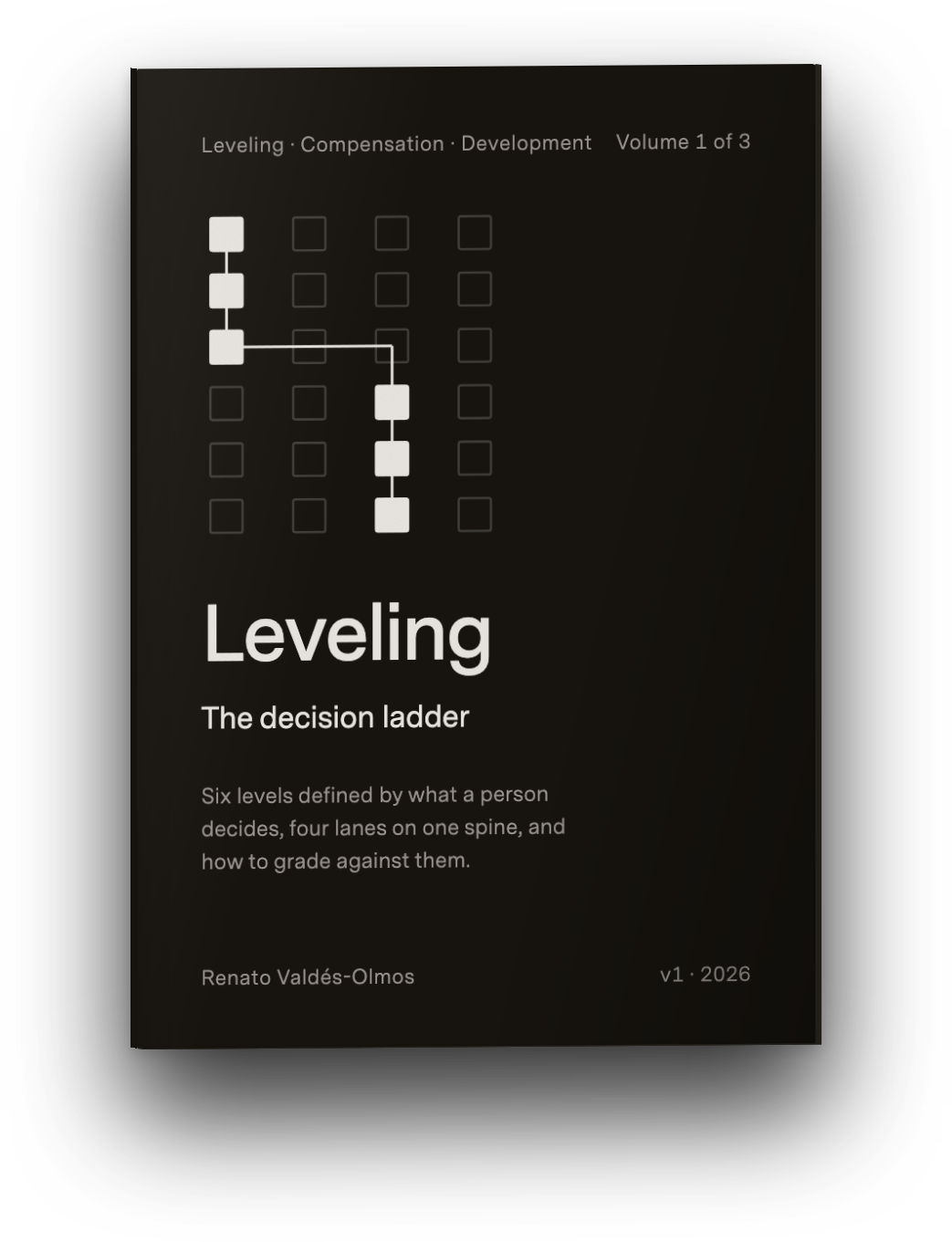
An essay can tell you the six rows stopped working. It cannot sit in the room in November when two managers disagree about the same person and neither can say why. That is what the workbook is for: one shared core across Engineering, Product, Research and Design (EP(R)D), six levels defined by what a person decides, and the mechanics to grade against them without the cycle turning into a negotiation.
Six levels defined once, by what a person decides alone. The shaded band is the overlap, where most of the work now belongs to no single lane. The marks to the left of each cell are doors: a move sideways at the same level, which is a transfer and not a demotion.
Written to be opened during a cycle rather than read once: on the page, as a PDF set to print, and with the templates as a spreadsheet.
Define it
Grade against it
Run the cycle
Or read section two, free.
v1. The cycle, the calibration room and the evidence standard are the ones I have run at companies of 25, 250 and 2500 people; the six axes are new. One payment, every revision by email.
One of four, each taking a function through the same framework; the system they share is set out in full in the workbook. The others are on design, engineering and product. Written from having inherited, run and rebuilt leveling and review cycles at three companies of very different sizes, and against the public frameworks that preceded them: the levels framework in Org Design for Design Orgs by Peter Merholz and Kristin Skinner, Rent the Runway’s engineering ladder, and Ravi Mehta’s product competency toolkit. Figures from the AI in Design Report 2026 and Figma’s State of the Designer 2026.
© 2026 Renato Valdés-Olmos